

Wednesday 16 September 2026
Science and the Scalford Sword Pommel Cap
Helen Sharp, LAHS Trustee and Curator (Archaeology) at Leicestershire County Council Museums looks into what scientific analysis can tell us about the Scalford sword pommel.
In 2017 Leicestershire County Council Museums acquired the wonderful Scalford sword pommel cap, thanks in part to a generous donation from Leicestershire Archaeological and Historical Society.
The pommel was found by a metal detectorist in 2016. It is a cast gilded silver object dating to the early Anglo-Saxon period; 6th – 7th centuries AD and would have been mounted at the end of a sword handle.
After acquisition the pommel was conserved by Michelle Johns at Lincolnshire Conservation so that soil and corrosion could be removed. During this process Michelle examined a substance that was initially thought to be green corrosion. However, when looked at under a microscope, the material appeared glassy so Michelle wisely decided to leave it intact and suggested we commission further scientific analysis to confirm her suspicions.
In January 2019, Dr Eleanor Blakelock (then working at ArchaeoMaterials, based at the Institute of Archaeology, University College London) analysed the green substance using a scanning electron microscope with energy-dispersive spectrometer. The analysis suggests that it was an inlay, with the top layers having a chemical composition similar to corroded glass. In places it appears that the inlay had extended over an edge, which suggests that it was inlaid in a viscous state, suggesting some form of enamel.
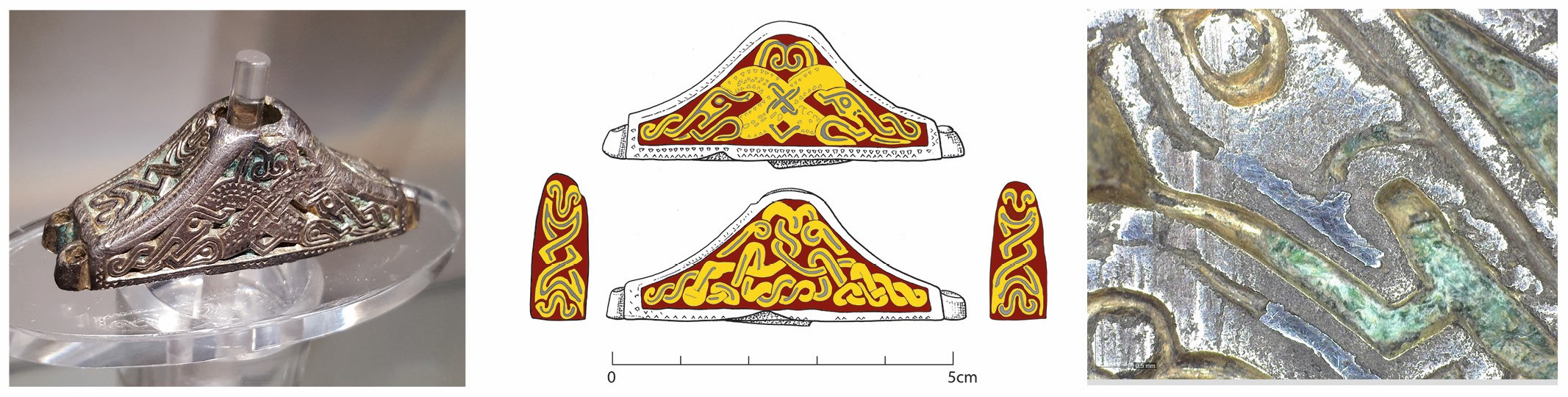
The term ‘green’ is used to refer to the material investigated, however it should be noted that the term refers to its current weathered appearance, since we cannot be certain of its original colour. Perhaps it would originally have been a red colour, as suggested by the presence of copper and also small quantities of lead.
The pommel is very similar to examples found in the Staffordshire Hoard, some of which also have a green material present. This was analysed by Prof. Martinón-Torres in 2016 but conclusions could not be drawn at that time. Dr Blakelock described the Scalford pommel as the “missing link” to explain manufacture of the Staffordshire Hoard pommel. The Scalford pommel shows that enamel was used to decorate pieces of high-status Anglo-Saxon metalwork which adds another level of craftsmanship to appreciate on these wonderful objects.
Leicestershire County Council Museums were able to purchase the pommel cap thanks to grants from the ACE/V&A Purchase Grant Fund, The Friends of Leicester and Leicestershire Museums and the Leicestershire Archaeological and Historical Society. Its accession number is X.A135.2017.0.0.
The pommel is now on permanent display at Melton Carnegie Museum, Melton Mowbray. A more detailed examination of the object can be read in volume 93 of Transactions of the Leicestershire Archaeological and Historical Society (click here for article).