
Friday 20 March 2026
Old Inns of Wigston Magna
Steve Marquis takes us on a tour of the many inns of Wigston Magna, from the middle-ages to the 19th century.
During the Middle Ages, there was only one, possibly two, inns in Wigston; it must be remembered that until the 19th century, the population of the village never surpassed 2,000, usually far less, and so lacked sufficient potential customers to sustain any more. Other reasons for the dearth of public hostelries included the limited variety of alcoholic beverages available during the medieval period. Ale (cider in some regions) and wine, occasionally mulled into mead, were the only accessible alcoholic drinks for inns to sell, and wine was far too expensive for all but the very wealthy.
The fact that most households brewed their own ale, with a few producing a regular surplus, which they would sell to their neighbours in what became known as ale houses, added to the lack of demand for taverns. A great deal of ale was consumed, not because fresh water was unsafe; that is a myth, apart perhaps in the centre of large towns. Ale, made from fermented barley, was a substantial part of the daily diet. It was full of calories and vitamins and tasted a lot better than water; tea and coffee weren’t readily available to the masses until the 19th century. Brewed beer wouldn’t become widely accessible until the 16th century, and distilled spirits appeared in England only in small quantities, mainly as medicinal elixirs, sold in apothecaries until the 17th century.
Whisky (uisce beatha ‘water of life’) emerged in Gaelic Scotland and Ireland during the 15th century, and vodka a century later, after trade links were established with Russia, but initially only in a few ports. Brandy and gin became available only at the end of the 17th century, with mass-produced gin so cheap that it led to the infamous ‘gin craze’ of the 18th century.
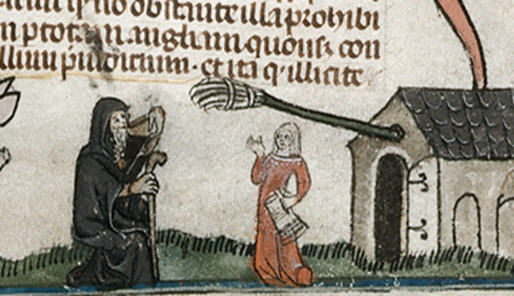
During the Middle Ages, alewives were central to the brewing process, particularly in England and northern Europe. Brewing ale was considered a domestic task, and women brewed small batches at home, sometimes selling any surplus to neighbours and passersby. A few women would make brewing a more regular business by displaying a broomstick or greenery outside their homes to advertise that ale was for sale. One reason, perhaps, why the broomstick became associated with witches. The role of the alewife was so significant that early brewing laws and regulations often specifically referenced women.
Beer brewed from imported hops wasn’t available in Wigston until the 16th century. The use of hops in a slightly more complex brewing process resulted in a more reliable and consistent drink that tended to last longer than traditional home-fermented barley ale (which had to be consumed almost immediately), encouraged the growth of inns and taverns, which gradually replaced alehouses. The growing consumption of beer encouraged the expansion of commercial brewing, with male-led guilds taking increasing control. This transition, coupled with laws limiting women’s independence, led to the decline of alewives as a profession. It also meant that men now mainly replaced women in the brewing industry. There is some evidence that several buildings on Long Street near the entrance to today’s Central Avenue were used to brew Wigston’s beer at the time, which was then circulated to the local hostelries. The number of inns in Wigston probably increased to three or four during the 16th century as the population grew steadily. It was during the second half of the 1500’s that we first get the names of Wigston landlords, Henry White and his son Robert, who were listed as innkeepers, but not the name of the establishment they were landlords to.
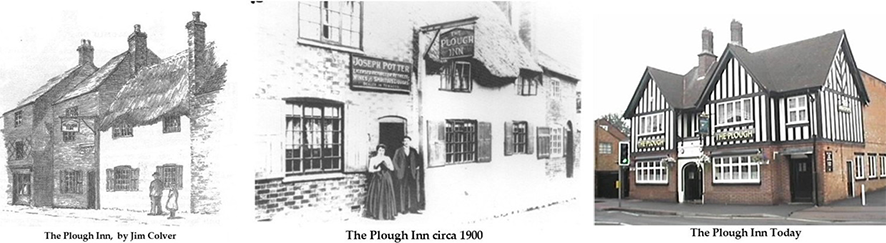
The Plough Inn: Situated in Bushloe End, this is almost certainly the oldest inn in Wigston. Its name derives from the fact that, during the Middle Ages, heavy ploughs and other shared farm implements were stored communally near All Saints Church. It was certainly there in 1390, when Richard Baker was battered to death outside the inn by Adam Sutton using a wooden stave. Adam de Sutton was the second husband of Baker’s mother, Emma, and it seems that Baker was about to lose his expected substantial inheritance to his stepfather. Just one of seven murders recorded as occurring in Wigston between 1299 and 1390.¹
It wasn’t until the 1846 Trades Directory that the Plough Inn actually appeared in official records, which also listed its then-landlord, Elizabeth Burbidge, who had been preceded by Henry Burbidge from 1828 to 1835 and then by Richard Burbidge until 1841. Elizabeth was the widow of Richard Burbidge. It was held for the next 60 years by members of the Potter family and, from 1912 to 1925, by Thomas Bull. Later landlords included John Walter Clarke during the Second World War, Frederick Stapleford, and, after it was demolished and rebuilt in the 1950s, Harry Herbert. For a period, it was renamed the ‘Sundowner’.
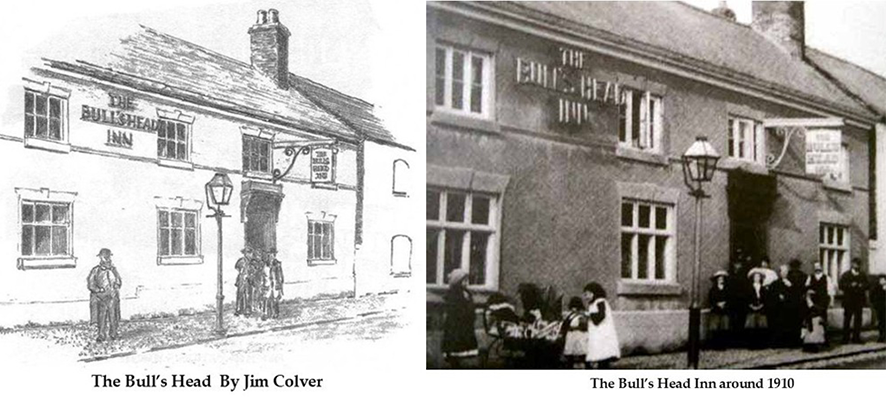
The Bull’s Head: We know that the Bull’s Head was in existence in 1617 because it was mentioned in the notorious Boulter via Noone libel case of 1637-38. This case resulted from a drunken brawl outside the inn; the Boulters were the landlords at the time. It is possible that an inn may have been there far longer; it is even conceivable that it was actually the first in the village. Being situated on the main road between London and Leicester, it was ideally placed to cater for travellers along that route. Although there would have been relatively few travellers during the Middle Ages, it is still likely that there would have been at least one inn to meet their needs in the village. Whether this was the Bull’s Head or another, we’ll never know. Most readers would probably assume that the inn took its name from the road it was situated on, but, in fact, the opposite is true. When the inn was first built, the road was called Spoutlewell Street (a section of the main Welford Road) and later became Bull Head Street, named after the inn.
In June of 1964, a major fire caused extensive damage to the upper floor. The inn was demolished in 1972 as part of a major road-widening scheme.
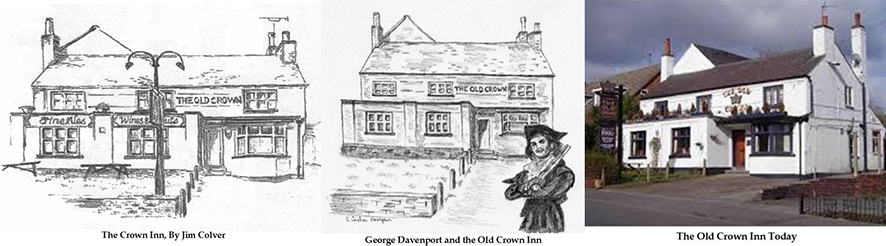
The Old Crown Inn: This inn is, of course, closely associated with Wigston’s infamous highwayman, George Davenport (LAHS Blog 11 May 2025). His father, William, was the landlord for a time (though probably before George’s birth), and there’s the story of George regularly performing a jig on its roof, which he called the "Astley's horn-pipe" (probably named after a friend). It was also at the Old Crown Inn that George was turned over to the authorities by its landlord, Mr Barnes, in 1796. The Inn was one of the earliest brick-built buildings in Wigston, probably constructed around 1750; other early examples included John Pochin’s farmhouse (1691) in nearby Newgate Lane and the ‘Elms’ built by Samuel Davenport, George’s uncle, in 1752.
Coincidentally, the Old Crown Inn was again in the hands of the Davenports in 1846 when it got its first official mention in that year’s Trade Directory. George Davenport was named as the proprietor. One suggestion for the origin of its name is that it might be connected to King Charles I's visit to Wigston in 1634, two years after the roof of All Saints Church collapsed and a possible donation from the king towards its restoration.
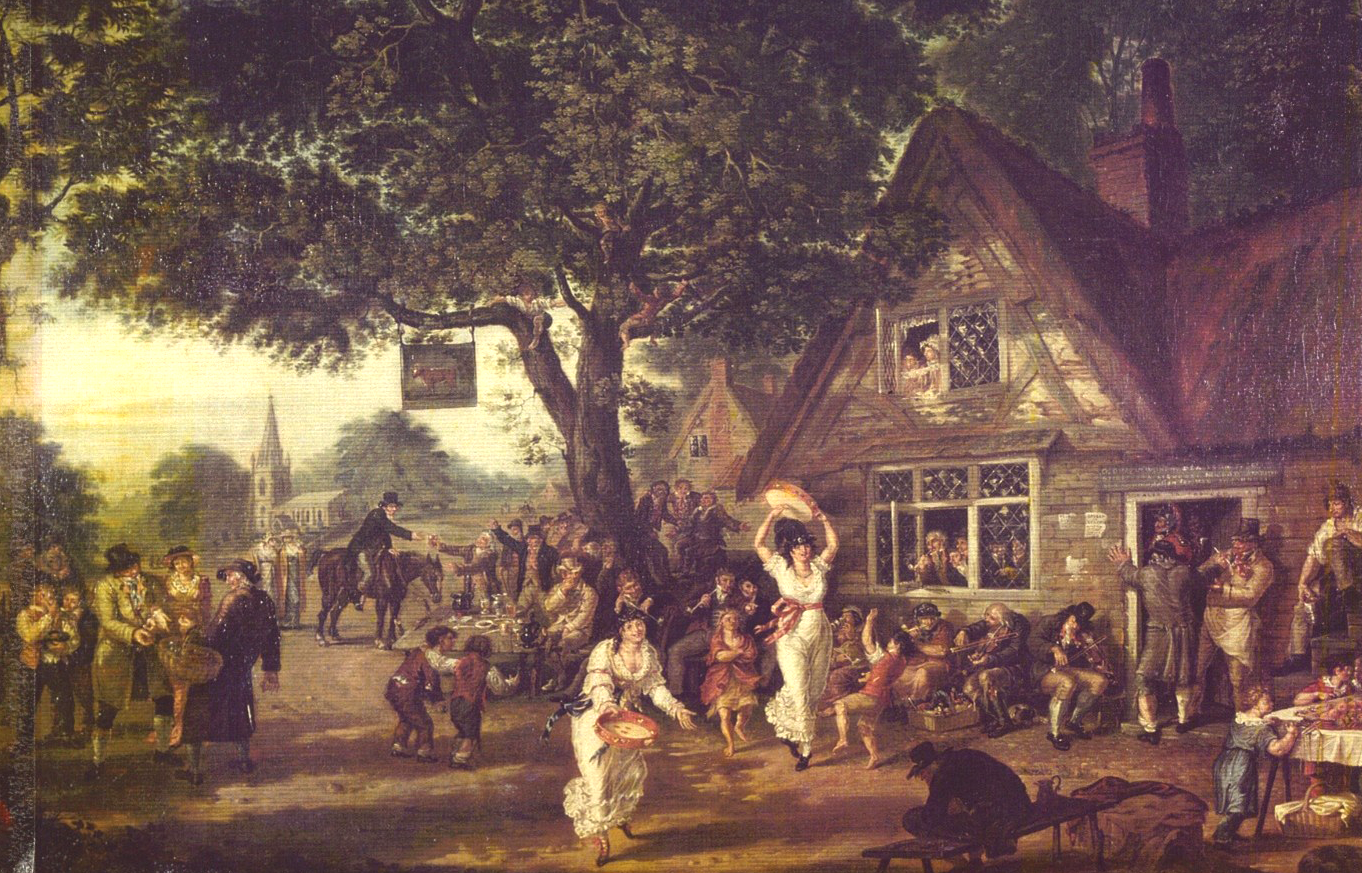
Durham Ox Inn: Built around 1800, it was originally called ‘The Woolpack’ until 1817, when it was renamed the Durham Ox Inn. Perhaps linked to the original Durham Ox Inn featured in the 1790’s oil painting below. Whether there was some kind of transfer of name when the second Durham Ox was built on Long Street shortly after the painting was produced, we’ll probably never know.
During the 19th century, the publicans of the Durham Ox were members of the Fox family. Edmund Fox took over the Inn in 1825. He had originally arrived in the village after marrying local Mary Humberstone in 1806. In 1834, Edmond was found hanging in his own establishment after committing suicide. Having lost her husband, Mary Fox would later experience the trauma of being burgled.
The Blue Bell Inn and The Horse and Trumpet: During the 18th century, improved roads, especially the construction of new turnpikes, led to quicker and more comfortable journeys, resulting in many more people travelling by coach. Wigston, being on a major route from London to the north of the country, brought more visitors to the village. As a result, two new coaching inns were built. The Horse and Trumpet on Bull Head Street (its name clearly denoting its origins), and the Blue Bell Inn, later renamed The Bell, situated on Balle Dyke Street (later renamed Bell Street after the Inn). The Bell moved onto the Leicester Road in 1860 after the original was demolished in 1847.
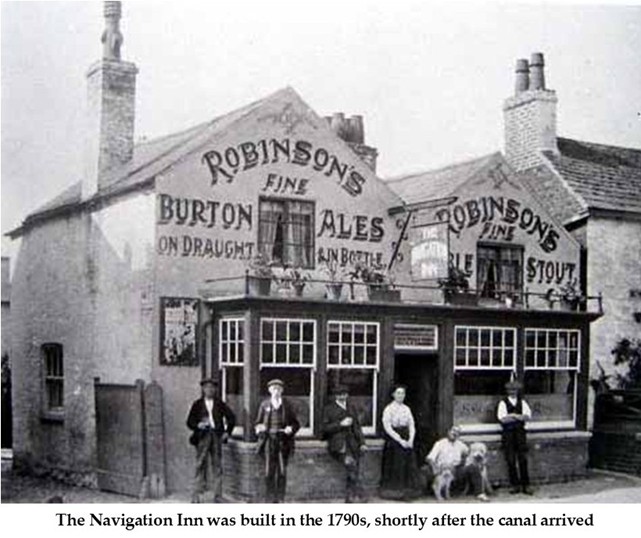
Kilby Bridge – The Navigation: The hamlet emerged during the 1790s, when the Leicestershire and Northamptonshire Union Canal reached this point on the Welford Road, a crucial route from London to the north. The new wharf enabled easier access to large bulk cargoes, such as building materials, which facilitated the rapid expansion of Wigston during the 19th century.
The 19th Century and Industrialisation
During the 19th century, Wigston was transformed from a rural village into an urban industrial town. Its population increased from 1,658 in 1801 to over 8,000 by 1901. The arrival of the railways and the boot and shoe industry, which, along with hosiery, was moving increasingly from domestic to large-scale factory production. Retail outlets also increased rapidly in line with the growing population. More people provided more customers for public houses, and their numbers grew substantially during the 1800’s.
The Shoulder of Mutton Inn was situated on Long Street opposite today’s post office. First listed in 1846 with John Cooper as landlord. It was demolished in 1895 and replaced by what would be commonly referred to as the ‘Devil’s House’. Home of Robert Ross, headmaster of the ‘Nashes’ next door, circa 1900, the oldest school in Wigston, Robert was the father of impresario Donald Ross.
King William IV was built in the 1840’s on Bell Street and was kept by various members of the Goodwin family from 1846 until 1861, and for a further 29 years between 1889 and 1928 by the Hursts. It was demolished after the Second World War, and the license was transferred to the new Nautical William on Aylestone Lane in the 1950s, when the surrounding estate was built. Also shown in this drawing is part of Garforth's fish and poultry shop, which stood on the corner of Bell Street and Long Street. This had been removed some years earlier.
The Queen’s Head Inn was built in 1846. The 1851 census has an entry for a William Vann, Licensed Victualler, of the Queen’s Head on Bull Head Street.
The Railway Hotel was built in 1852. With the advent of the railways, many hotels and public houses were built and named accordingly. Wigston Magna was no exception, and this hotel one on Station Road stood alongside the level crossing before the 'Spion Kop’ bridge was built and the road straightened, to some extent, by-passing the hotel. Unlike many other 19th-century pubs, the Railway Hotel is still in business, even though its name keeps changing.
The new Royal Oak, Leicester Road, was rebuilt in the 1930s. The Star and Carter, Leicester Road. The Wigston’s Working Men’s Club. Perhaps worth a mention is the Wigston’s Working Men’s Club, the second-oldest Working Men’s Club in England, built in 1862 and demolished in 2008.
---
1. William G. Hoskins, Murder and Sudden Death in Medieval Wigston, LAHS Transactions, 1939. Hoskins mentions seven murders between 1290 and 1390, whose records survive because the perpetrators all received Royal pardons, so there may have been more homicides where pardons weren’t obtained. The Middle Ages were far more violent than today, according to historian Lawrence Stone; the murder rate was ten times higher.
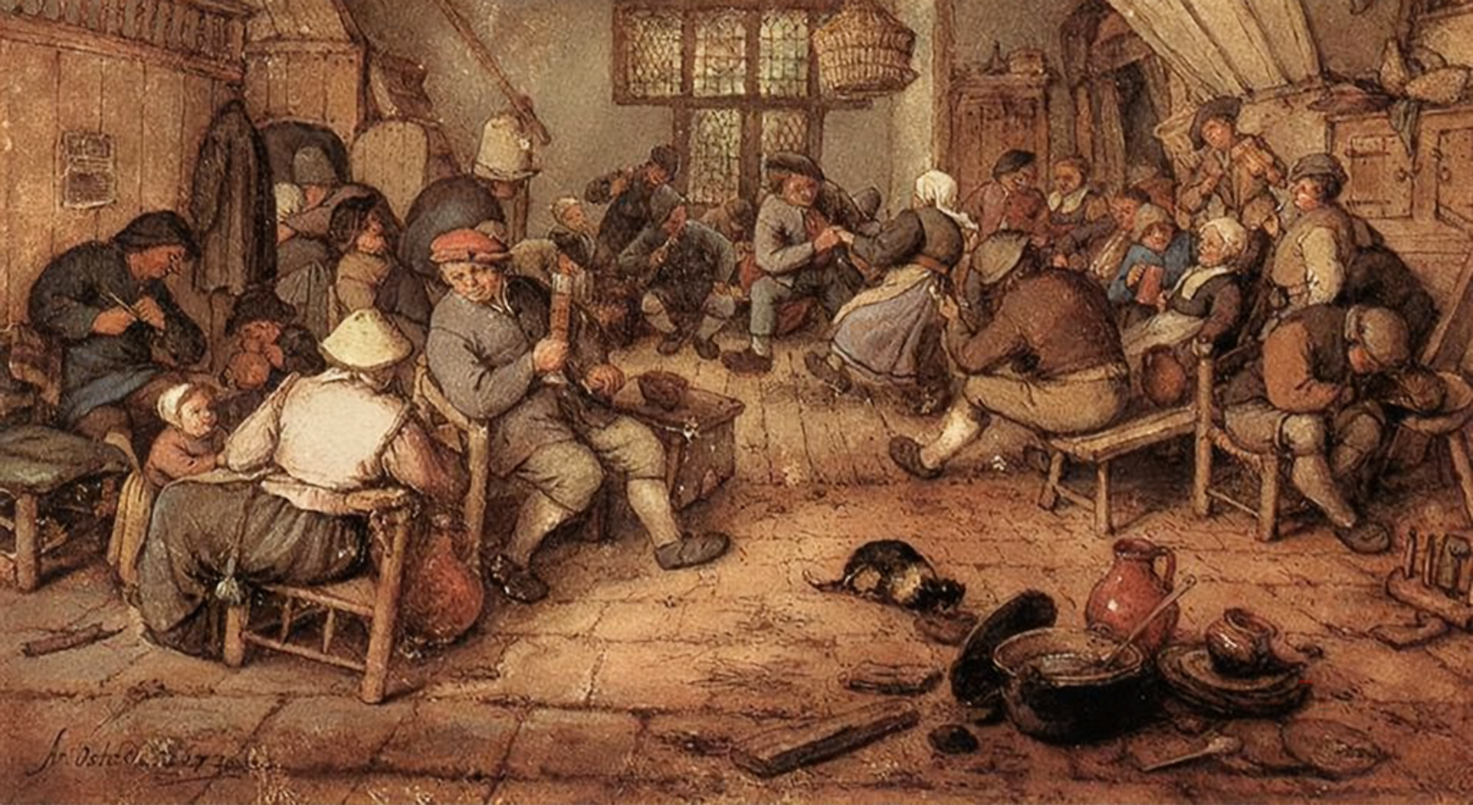
Background image: Peasants Feasting in a Tavern, Adriaen van Ostade, 1673
Peasants Feasting in a Tavern, Adriaen van Ostade, 1673